The most controversial and most divisive game in the history of video games - how true is it?




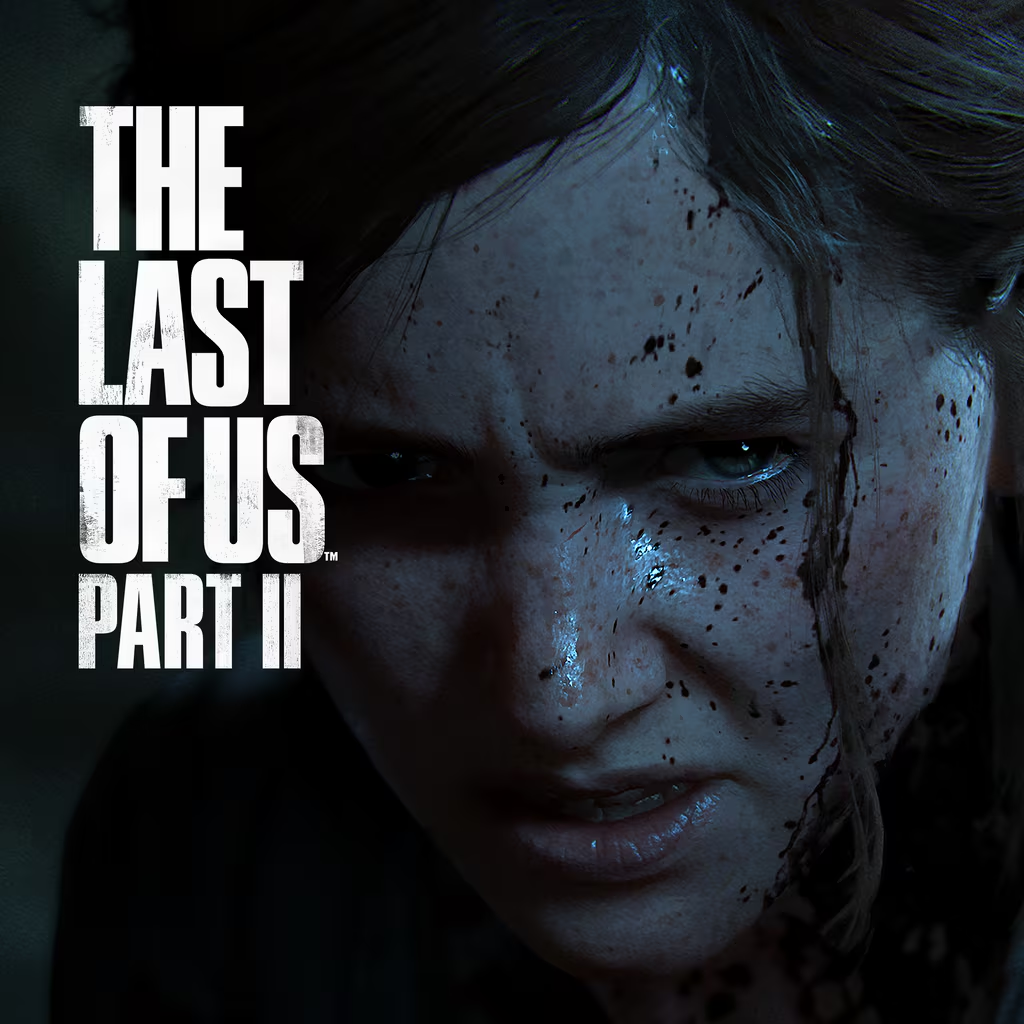
Image credit: PlayStation / Sony Interactive Entertainment promotional art.
Source: PlayStation
Summary
- Name of the game: The Last of Us Part II
- Launch date: June 19, 2020
- Developer: Naughty Dog
- Publisher: Sony Interactive Entertainment
- Platforms: PlayStation 4, PlayStation 5
- Genre: Action and adventure, survival horror
- Context: Post-apocalyptic world devastated by a pandemic caused by a cordyceps fungus that turns people into aggressive creatures. The story takes place years after the events of the first game.
History and narrative
The game's story takes place years after the close of the first title, with a 19-year-old Ellie embarking on a journey of revenge that takes her across a United States still infested with the infected and plagued by human conflict. This time, the focus goes beyond simple survival where it dives deep into themes of hatred, loss, trauma and redemption. Character development is quite complex and emotionally charged. Ellie and other new characters present a range of moral nuances rarely seen in video games. The script is mature, deep and symbolic, though more on that later.
At a narrative level, the world, although with a linear design, is full of details that enrich the atmosphere. Unlike the first part, this sequel is much darker, more risky and moves away from that sympathy towards the protagonists. Before we focused on Joel and Ellie, now the game divides opinions and bets on a different narrative. In short, this story is about revenge, hatred and all the consequences that this brings on a personal level.
One of the strongest points is how morality is brought up. The game constantly makes you question whether what you are doing is really right. Many players justify actions because of what happened before, while others reject it regardless of the context. The truth is that it's a story that engages and makes you want to know what happens next. It's a narrative that leaves no one indifferent: you either love it or hate it, but neutral almost doesn't exist. And yes, it is controversial, because it breaks with much of what we saw in the first part.
Now, this installment stops focusing so much on the infected, which were an essential part of the first game. Here they pass to a third plane. They feel more like generic enemies, with no real relevance to the story. If you remove them, everything is still understood the same. The narrative focuses entirely on a group of people and their personal conflicts, not on eradicating a global infection. Yes, the infected have enhancements, but they are not crucial to the development of the narrative.
Another aspect that did not convince me was Naughty Dog's handling of the cinematics. It's not about the quantity, but the narrative quality they offer in the context of a video game. On several occasions I felt like I was watching a streaming platform series rather than playing a video game. Some scenes go on too long and, instead of adding to the interactive experience, they interrupt it. While they are well produced and could work very well in a TV series, within the game many of them feel unnecessary and add no real value to the pacing or gameplay. In that sense, I think a bit of focus was lost with respect to the nature of the medium and the type of audience it is aimed at.
Spoiler alert
Let's get to the point: the game became controversial because of the studio's decisions, especially Joel's death, which literally broke the internet. Why? Because the fans had a huge affection for him, and the way he dies was shocking, violent and, for many, absurd. But if we are objective, in the first game Joel was not exactly a “good guy”. He was a broken man, affected by the pandemic and who, at the end of the previous game, did something extremely selfish: he chose to save Ellie instead of allowing a possible cure for humanity. He did it out of love, yes, but also because he couldn't lose someone again. Joel represents the phrase: “I choose to save my world”.
The problem lies in how he dies. Joel and Tommy, being so cautious, suddenly trust strangers and it costs them dearly. It feels forced. His death, beyond being Abby's revenge, feels like an excuse to get a character out of the way who no longer “worked” for the story according to the writers. They kill him off too quickly, coldly and without much development. I'm not saying that he didn't deserve to die, but I am saying that his exit was poorly executed and very rushed, considering that it happens in the first hours of the game.
From there, the real story begins. Ellie wants to avenge Joel and goes to Seattle to look for all those responsible. There we are put in the middle of a civil war between the WLF (wolves) and the Scars (a religious sect). Ellie kills dozens of people on both sides to accomplish her goal. But the big problem comes at the end, her main objective is not fulfilled. After everything she did, after leaving her family and not being able to leave the past behind, she decides to forgive Abby, why?
There is no clear reason. The whole game pushes you towards that goal, and in the end throws it away without a good justification. Ellie ends up alone, fingerless, partnerless, childless, and without fulfilling her revenge. It's a complete throwback, not character development. An incomplete, unsatisfying and contradictory ending for many and I empathize with those who felt that way because for me it was.
The other thing that didn't work either was splitting the story between Ellie and Abby. The narrative resource of playing with Abby seems to be made for us to understand her and empathize with her, but it doesn't really work. I must be honest, I enjoyed Abby's part more than Ellie's. In this installment, Ellie seemed to me a character completely dominated by hate, vindictive, selfish and even ungrateful. She's immune, she has a family, and yet she decides to give it all up by continuing the same thing over and over again. And she doesn't even finish what she started.
A lot of people hated Abby for killing Joel, I get that, but her motives at least were clearer. She forgave Ellie at the beginning, she had no real interest in hurting him. Meanwhile, Ellie kills all of Abby's friends and still decides not to kill her. It doesn't make sense. The game puts you on a scale, but doesn't give you a clear conclusion. It doesn't quite know what the message is: revenge is bad? Then why did you make me look for her for 15 hours? It is very interpretative the reason of what happened, however, it was not what the player expected from the game and less when the game itself gives you to understand a message which is discarded in minutes.
In the end, the story is remembered more for its controversy than for its goodness. And bluntly the narrative is the weakest point of the game, far below the rest of the sections, plus in my opinion leaves much to talk about and I can not call a good story when it generates too much controversy in its narrative, certainly did not meet the expectations of the first game in this section.
Gameplay
The Last of Us Part II's gameplay is a beast. It's simply incredible. Everything you can do, the possibilities you have, the details are brutal. They improved a lot compared to the first one: now there is more verticality, more interaction with the environment, it feels much more tactical and free. You can make a thousand different strategies for each combat. At a playable level, this game is a 10 without thinking about it.
The stealth is deeper, the combat is more physical and visceral, and the AI of both humans and infected is much more intelligent. Mechanics such as crawling are introduced, dynamic cover can be used without having to press buttons, and there are also sniffer dogs that follow your scent, which adds tremendous pressure. Add to that the fact that you can hide in tall grass, under vehicles, use debris as hiding places, everything is designed so you can play as you please.
There are new weapons like the crossbow or a double-barreled shotgun, and all of them can be upgraded in workbenches with materials you find while exploring. They also added new enemies like the Shamblers (who shoot corrosive gases) and unique bosses that make you think more about your moves. The combat system is so realistic that each confrontation feels different.
The AI is crazy: human enemies shout the names of their compatriots if you kill them, they communicate, they change their patrol if they see a body lying around and it even depends on which faction they are (the WLF or the Seraphites). All this makes the game very dynamic and keeps you on your toes all the time.
Although it is not an open world, there are huge areas like downtown Seattle where you can ride horses, find secrets, chests, hidden weapons, and expand the story a little more. The puzzles are simple, but they have the fun of moving objects, activating generators, using ropes in a realistic way, nothing out of this world, but well implemented.
The controls are super responsive. Everything flows naturally: run, shoot, dodge, melee. The new dodge mechanic greatly improves duels. In short, everything is so well polished that it's a pleasure to play it. You can see the care they put into this part.
Graphics and visual design
This game is as graphically top notch as you're going to find on PS4. It's crazy how it looks. The modeling, the facial expressions, the lighting, the details in every corner are hyper-realistic and cinematic. It really pushes the console to the limit and you can tell they squeezed every drop of power out of it.
The scenery is beautiful, even in darkness and chaos. Seattle is recreated with an impressive level of detail. There are places that stick in your mind because of how well done they are, like when you see cordyceps spores coming out of the walls it's so real that it makes you uncomfortable, and that's just what they were looking for.
The combat feels well thought out visually as well. The scenarios are built so that you can sneak around or fight in different ways, which adds a lot to how you want to approach each situation. In my opinion, it's the best PS4 game in terms of graphics, no contest.
Sound and music
Gustavo Santaolalla returns and, as always, his music is minimalist, melancholic and powerful. I liked it, although I feel it is not at the level of the first one. Even so, the soundtrack is brutal. The gunshots, the screams, the sound of the infected make your hair stand on end and put you right into every tense moment.
But what stands out the most is the voice acting. Ashley Johnson (Ellie) and Laura Bailey (Abby) deliver impressive performances. They convey every emotion, every moment of anger, sadness or doubt with tremendous credibility. The original version is light years above the dubs. A first class quality.
Difficulty and accessibility
The difficulty is very well adjusted. There are several options depending on what you are looking for from very easy to survival. Some parts are more challenging than others, but it never gets frustrating. I found everything to be a bit easier than in the first game, including the puzzles and the search for resources. Maybe they did it this way because for some people the first game was a bit complicated, although personally I didn't find either game difficult.
And something to applaud Naughty Dog for is the accessibility issue. There are more than 60 options for people with visual, hearing and motor disabilities. It's one of the games with more work in this aspect that I've seen on PS4, and that deserves a lot of respect.
Additional content
The campaign lasts about 25 hours, which is perfect. It has the option to select chapters, upgrades, unlock models and filters, but honestly, while it tries to be replayable, it doesn't quite pull it off. The story is so emotionally intense and polarizing that many people don't feel like going through it again. There are no narrative DLCs, but they did add a free Permadeath mode and Grounded mode for those who want an extra challenge.
Technical Aspects
Performance is solid. On PS4 it runs great, and on PS5 it runs at 60fps smoothly. Almost no loading times. In my experience I didn't run into any bugs or glitches. That says a lot about how well optimized it is. On a technical level, impeccable.
Value for money
It came out at $60, and even though it's a single player game, for the overall quality it's justified. But if you ask me, I bought it for $30 on sale and I think at that price it's totally worth it. Even 40 would be fine. 60 might be a lot if you don't connect with the story, which is very divisive. But overall, yes it is a game that justifies its price for everything it offers.
Trophies / Achievements
- Platinum obtained: No.
- Percentage of trophies obtained: 30%
- Estimated time: 25-35 hours
- Platinum difficulty: 2 out of 10, the platinum is too easy, but a bit boring for having to resort to extensive video guides.
Conclusion
The Last of Us Part II is an ambitious, emotionally complex and technically impressive game that defies the conventions of storytelling in video games. It is not for everyone, especially for its raw tone and risky decisions, the game is an artistic beauty, good performance, good gameplay however in a single player game the story and narrative have a huge weight which it does not fulfill in a good way and is a game remembered more for how controversial it was than for any other reason. In my opinion it is a masterpiece in everything but the story and narrative, I do not think that for having been so controversial and generate so much division of opinion, I do not think it deserved its award for GOTY of 2020 and less to have won the best narrative game of the year. If I consider that you should try it to have better criteria and it is worth it, the game is fun and entertains you, but if you will find questionable decisions.
My final rating for The Last of US Part II is:
3.9/5