
The game that culminated a saga that marked a generation of gamers, the game that knew how to close a trilogy.




Image credit: PlayStation / Sony Interactive Entertainment promotional art.
Source: PlayStation
Summary
- Name of the game: God of War III
- Launch date: March 16, 2010 (PS3) / Remaster 2015 (PS4)
- Developer: Santa Monica Studio
- Publisher: Sony Computer Entertainment
- Platforms: PlayStation 3, PlayStation 4 (Remastered)
- Genre: Action, adventure, hack and slash
- Context: Greek mythology, dark fantasy and epics
History and narrative
The game for which many bought their PS3. I remember perfectly how this title was the one that boosted the sales of a console that, at the time, was not justifying its price. God of War III directly follows the events of what, in my opinion, is the best PS2 game: God of War II. This game leads Kratos to go completely mad and to be driven only by anger and thirst for revenge against the gods of Olympus, after several years of having served them. The betrayal of Zeus was the last straw that broke the camel's back, and with just cause.
The game is summed up in the chaos and destruction of the Greek deities, and its main message revolves around the consequences of Kratos' all-consuming hatred. It has to be said: for years, in my opinion, it was the best intro a video game has ever had. A Zeus giving a speech, the Titans scaling Mount Olympus and the gods preparing for a war they had won years ago. The amazing thing is that, despite everything, the titans in their revenge were still far inferior to the gods; if it wasn't for Kratos, at the beginning of the game Poseidon would have torn Gaia apart.
In this game, Kratos is very “chetado” and is practically unstoppable. Something that discourages the pace a bit is when, after defeating Poseidon at the beginning, we climb to the top and Zeus, with a single attack, sends us to the underworld. However, a surprising moment is when we learn that Gaia was just using us and that we were her pawn, a simple resource to have a second chance against the gods and try to rule the Greek land again.
In a way, some souls from the underworld take away our life, magic and collected orbs, which is a bit demotivating, since in God of War II This made more sense because of Zeus' trap; here it doesn't. Here you simply fall into a river and some souls take all your resources. Here you simply fall into a river and some souls take all your resources. Also, after that, they change us the Swords of Athena for the Swords of Exile, which are not bad, but Athena's look better.
On a narrative level, the game expands a bit more on major aspects, such as what led Zeus to his betrayal, the secrets of Pandora's Box, and a bit more about how the world is constructed. However, you get to know little to nothing about some of the titans that appear on screen, various gods of Olympus, and other supporting characters. Still, the characters deliver well enough in strength and presence. Obviously, Kratos gets the credit: an anti-hero driven by rage, while the gods are motivated primarily by fear.

In my case, I will always wonder what happened to Aphrodite. Theories point to her death; however, we don't see her death as such, only the intimate moment with Kratos. Perhaps it would have been better to include some kind of short combat, as the developers originally intended.
The story is quite well done, with epic moments, narrative clarifications, a darker tone and an incredible closure. It's a game that promises revenge and delivers from start to finish. Besides, its ending was satisfying and its post-credits scenes left thousands of players wondering what could have happened to Kratos. Of all the saga of God of War, this is undoubtedly the most brutal. I don't think it's the best because it wastes some moments with great potential, although that has more to do with its gameplay. At the level of story and narrative, it fulfills quite well.
Gameplay
The game maintains its essence and its hack and slash genre, which I have always loved, with easy to understand mechanics, simple and straight to the point menus, where you have weapons and use a score of red orbs to level them up by defeating enemies or finding chests. Easy and straight to the point to provide a good experience to the player without saturating him.

The combat is relatively fast; moments of waiting are needed, although being aggressive at times can help you a lot. It has a good variety of enemies, from cyclops, skeletons, centaurs, jellyfish, scorpions, mermaids and many more, which we can defeat with different weapons, each with its special ability, such as:
- The Swords of Exile
- The Claws of Hades (my favorite)
- The Cestus of Nemea
- Whip of Nemesis
- The Arch of Apollo
- The Head of Helios
- The Leaf of Olympus
- The Boots of Hermes
- The Swords of Athena (only available if you get an artifact and in New Game)
- The Wings of Icarus, which can function as a weapon, although they are not official.

Each weapon has its essence and its magic to be able to defeat all our enemies and the gods. With all this arsenal, plus the Golden Fleece and Kratos' ability to use the power of the gods, along with his curse of never being able to die, make him the perfect weapon; that's why Ares chose him as the perfect warrior. Puzzles are also part of the game, although the ones in this installment I think are easy; perhaps the most complicated is the Garden of Hera, and yet they still aid exploration.
Now, in this game we have the gorgon eyes, feathers and some horns. Before you had to collect five or six of these to raise your life or magic a bit; now there are only three, and I must say that these chests are better hidden than in other games.
The controls are very precise and responsive at the slightest touch, which gives the combat fluidity, and in moments where we have hordes of enemies, the mix of weapons makes it more dynamic, avoiding using only the main swords. In this installment, each weapon works better against certain enemies, although you can defeat them with any of them.
The learning curve of its mechanics is accessible to new players. You can perfectly pass the game using the square button, although it would become tiring and boring. It's so easy that the tutorials are just a mini-window telling you which button to attack with and which one to defend with; the rest is up to the player to explore.
Now, the most remarkable thing is undoubtedly its bosses. This game has the best of the saga, by far, without belittling the others, which also have many outstanding moments, but God of War III especially stands out in these fights. Below is my analysis of each boss:
- Poseidon: The best opening boss I've seen in the series and I think in many games. It's epic; from his entrance, taking down a titan with a single blow, he shows you that the god of the seas is one of the most powerful. He alone was able to take down several titans. His combat is divided into phases; the last one, where his true power is revealed, imposes quite a bit, though not enough to prevent Kratos from giving him a very violent death.
- Hades: Spectacular fight and very challenging. Its entrance trying to steal your soul and its size leave you with that feeling of “ok, this fight will be epic”. It is very well designed and can be long, even about 10 minutes or more, although it has save points. Cutting off parts of his body bit by bit, ripping off his armor and weapon, and Kratos humiliating him and then defeating him with his own weapon by stealing his soul is just epic.
- Helios: Here comes the first combat disappointment of the game, as you have to take him down to have a titan do the job for you and leave him badly wounded. The combat consists of defeating enemies using a cyclops and, once finished, Helios attacks you, but it doesn't represent anything. Mind you, his death was the most violent and merciless in the entire saga: tearing off his head and then using it as if it were a lantern. It shows how blinded Kratos was, and yet it's still epic.
- Hermes: Irritable character who earned his death for being a fool. The fight is practically chasing him, knocking him down and then facing him wounded, without much of a challenge. This fight could have been better. His death is Kratos chopping off his legs like an animal, that's what it looks like, and then putting on his boots. Awesome.
- Hercules: I did not expect this character to appear in the game. His appearance is due to envy towards Kratos, a sibling problem that is solved with blows. The combat is very good and balanced, even with his minions; it doesn't feel annoying that they're there, and you can even throw them against the boss. Another boss defeated with his own weapon. Hercules raises a platform, Kratos presses him with it, leaves his face exposed and beats him into the ground. Brutal, without words.

- Aphrodite: It is not a fight, although there was intense action in their encounter, undoubtedly the best intimate moment of the saga and by far. They could have done some short combat, as they had intended.
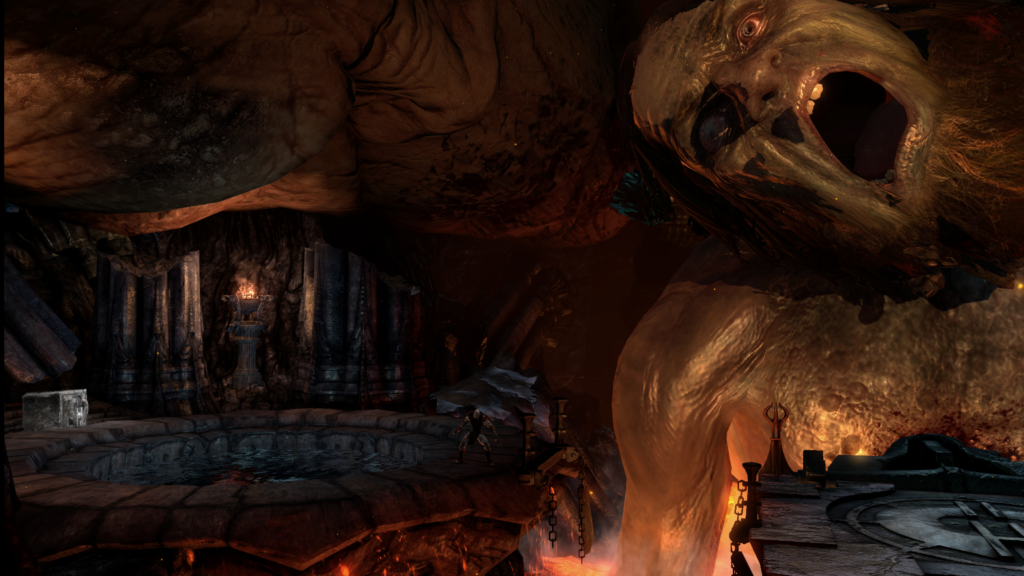
- Cronos: An unexpected fight for all players in their first game. Technically it's a fight, but because of the size difference it doesn't feel like the rest. It's a huge boss that demonstrates Kratos“ strength when Cronos tries to crush him several times and fails. He resorts to his secret technique, ”Cronos the baby eater“, and applies it with our protagonist, but it backfires so badly that Kratos, with the Blade of Olympus from within, pulls out his guts and his intestine is seen. Then he uses the ”belt" where he carries the Temple of Pandora to pierce him in the chin and finally stab him with the Blade of Olympus in the forehead. An epic death, but a painful one.
- Hephaestus: After his betrayal, which goes wrong, he dies practically electrocuted and pierced by a platform. It's not serious combat as such, but he still messed with the wrong Spartan.
- Scorpion: He's not a god, he's the guardian of the key to the labyrinth, but in my experience he's a tricky boss. His combat is very entertaining and gives variety to the bosses.
- Zeus: The boss that we were all waiting for and that left us stung in the previous game. His fight is divided into three stages: a very interesting 2D fight, another on Mount Olympus and the last one inside Gaia. Zeus demonstrates why he's so hard to beat; when you think you've got him, he just won't die. His combat is long to explain, but his death is very satisfying: you beat him until he dies and then you are given the option to keep beating him until the player gets tired. You can spend hours beating him even when he's dead. His combat was totally worth the wait.

There are very good mini-bosses. The gameplay of God of War III is excellent and delivers very well. Although it had more potential in some fights, each one has its epic moment.
Graphics and visual design
I remember in my childhood starting this game in 2010 and thinking it was just beautiful. At the time it was visually innovative and even today it still looks pretty good. The graphic section stands out for its detailed modeling, well done animations and spectacular scenery. For me, the best part is undoubtedly the boss design. I remember seeing a video inside the game where it was mentioned that the most difficult design was that of Poseidon, and no wonder: the level of detail it has is incredible and deserves all my respect towards the designers.

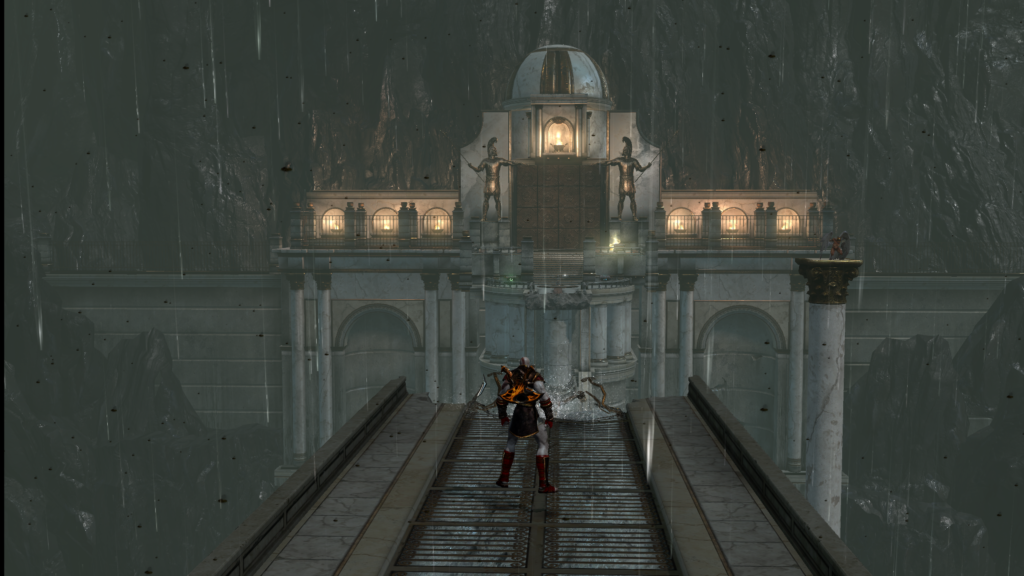
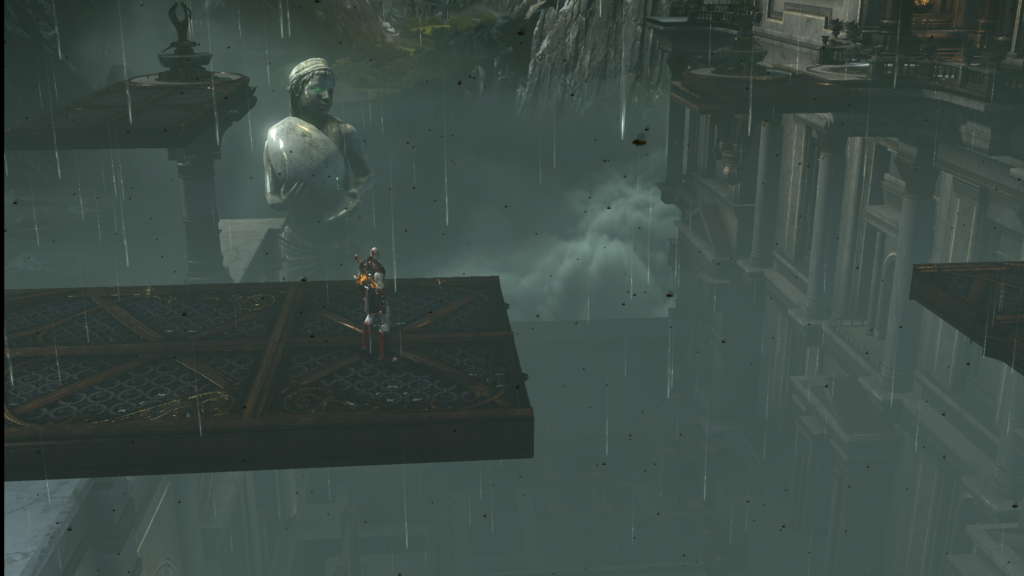
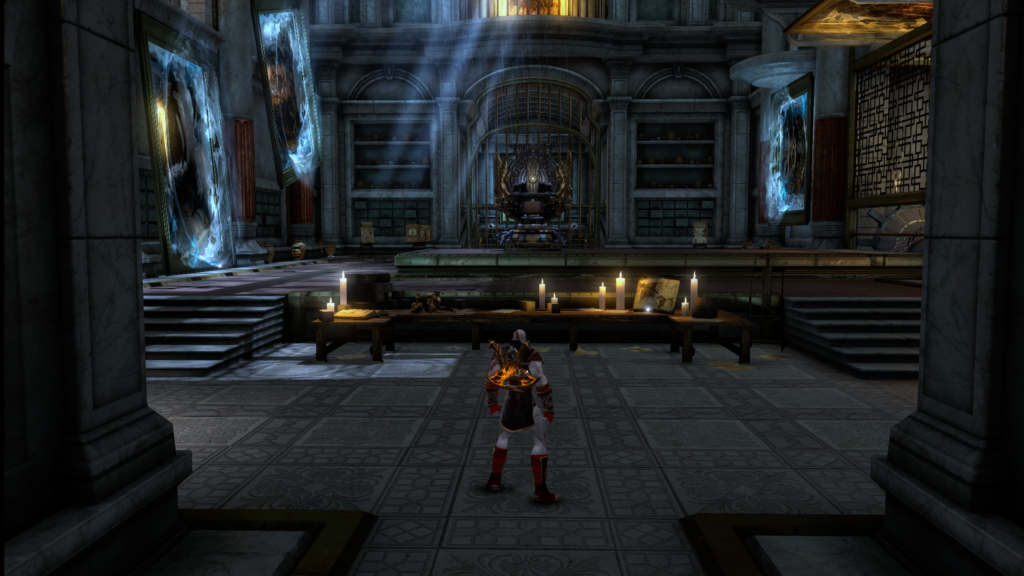
Scenarios like the labyrinth, Mount Olympus and the way the zones are connected make you realize that the entire game world practically functions as a large vertical tower. Its art style is epic and dark; you can clearly see that you are in the middle of a war and that the consequences of Kratos' revenge are reflected both in his look and in the world around him, where everyone suffers, since every death of a god has consequences.
The use of color, lighting and weapon design look great on a visual level. Its art direction is worthy of admiration and managing to convey that atmosphere of constant chaos makes the game something incredible.
Sound and music
The soundtrack is epic and powerful, conveying feelings of chaos, tragedy and grandeur. It's enough with the music that sounds when you start the game to know what you're going to: something epic, and the game delivers. Of course, there are moments where it reuses a lot of material from previous installments, so I think God of War II is still superior in this section.
I especially highlight tracks like The Wrath of Sparta, Overture and Brothers of Blood. Still, it must be said: the entire Greek saga, with its six games, has a brutal soundtrack.

The sound effects also convey a lot, from Kratos' screams and the impacts of attacks to the movement of levers. Everything has a recognizable and memorable sound - who doesn't remember Kratos pushing an object with a kick or opening a door?
The voice acting is solid. Without a doubt, Kratos' voice is iconic and conveys an imposing, serious and powerful tone that makes it clear that the situation is serious. The voices of Gaia, Athena, Pandora, Hades and Zeus also stand out, all very memorable.
Difficulty and accessibility
The game offers four difficulty modes, ranging from easy to very difficult: Spartan, God, Titan and Chaos. I consider the modes to be accessible in general, although I did find the Chaos mode very challenging, mainly because of the fight against Cerberus and the satyrs, which is, for me, the most difficult battle in the game and occurs near the end. There are other complicated moments, but this fight is the reason why many people end up leaving the game.
For a calmer experience, the normal mode offers a good balance, although in the end it's up to the player. I have played it on all difficulties and I have passed this game more than 20 times.

In terms of accessibility, for the time it came out it was fine. The remastered version includes some additional options, but don't expect too much. Compared to today's standards it falls short, although you have to understand the context of its release.
Additional content
The main campaign lasts between 10 and 12 hours. If you know the game well, it can easily be completed in about 5 hours. It's a short duration, but adequate for its genre. It has a very good replayability thanks to the new suits with special abilities and, being honest, almost everyone I know who has played this title ends up playing it again at some point in their lives. Personally, I've completed it over 20 times and it's still entertaining.

It includes the typical additional challenges, but it is not limited only to the seven classic ones, but adds more from the exile, so there is more content than in other games of the saga. There are also interesting artifacts for new games. Perhaps the only negative thing is that I didn't like Kratos' costumes or disguises that much; some I did, but in general I prefer the ones from other games.
Technical Aspects
In my experience, on both PS3 and PS4, both versions ran pretty smoothly with no major issues. There are minor bugs, but nothing that ruins the experience, mainly in the remastered version as far as I could tell. The optimization in general is well adapted to each console.
Value for money
At its release in 2010, the game was expensive, but totally worth it, especially if you were a fan of the saga. God of War III was a fad and one of the titles that propelled the PS3; without this game, the console might have lagged a bit behind. It was priced at $60 USD, which 16 years ago was quite a lot of money, and even today wouldn't exactly be cheap.

The remastered version was priced at approximately $40 USD at release, which was also fine. For me, both for the innovation as well as the technical leap and experience it offers, both versions justified buying at full price at the time. Today, that said, I recommend waiting for a bargain.
Trophies / Achievements
- Platinum obtained: Yes
- Percentage of trophies: 100%
- Estimated time: 15 hours
- Platinum difficulty: 4 out of 10. The platinum is the same as the others, get artifacts, upgrade Kratos, complete the game on hard and not on very hard mode which makes the platinum much easier and complete the typical additional challenges that are not impossible either. The rest of the trophies are only to advance in the story.
Conclusion
God of War III is the most brutal and direct culmination of the classic saga. It's a game that holds nothing back: it delivers on its promise of vengeance from start to finish, with epic scale, memorable bosses and a Kratos totally consumed by rage. Gameplay-wise it's solid, fluid and very accessible, with a combat system that, while it could have used its full potential better at times, is still extremely satisfying.
Narratively it closes the character's arc well, showing the consequences of the hatred and destruction he leaves in his wake, with a strong ending that at the time left thousands of gamers wondering what became of Kratos. Not the best God of War in everything, but the most violent, the most exaggerated and the most epic. A game that defined a generation justified a console and remains unforgettable within the saga. In a way, I feel that some aspects against bosses could have been better and for some reason I feel that it does not surpass the adventure of its predecessor.
My final rating for God of War 3 is:
4.4 / 5.0