

My personal experience with the samurai who betrays his code of honor for the survival of his people.




Image credit: PlayStation / Sony Interactive Entertainment promotional art.
Source: PlayStation
Summary
- Name of the game: Ghost of Tsushima
- Launch date: July 17, 2020
- Developer: Sucker Punch Productions
- Publisher: Sony Interactive Entertainment
- Platforms: PlayStation 4, PlayStation 5, PC (2024)
- Genre: Action, adventure, open world
- Context: Game set in feudal Japan during the Mongol invasion of the island of Tsushima in 1274.
History and narrative
What is the game about? Our protagonist, named Jin Sakai, is a samurai who must defend the island of Tsushima from the Mongol invasion. To begin with, one of the most interesting and motivating aspects to continue the game is its beginning, which, already with this premise, at least I was hooked enough to buy it. Normally PlayStation makes Japan-based games with samurai or other ninja themes, but they almost always include fantasy or mythological elements from this country, which are fascinating. However, The Ghost of Tsushima gives us a realistic story inspired by events of the Mongol invasion; of course, like any adaptation, not everything is 100% real. The best thing is to see a story of feudal Japan without fantasy elements and this already makes it a more original game than the rest of the same theme. It is very faithful to the period and I liked that.

Jin Sakai is a very interesting character, and his development is very unique, one of the best I've seen in a game. There are games that take several titles to develop a character or don't manage it at all; here, in a single installment, they develop him so well that at least his ending left me very satisfied. Jin lives a dilemma throughout the game between loyalty to his samurai code vs. survival, which is the main narrative point. This evolution is incredible because even we, as players in this era, would think that the most logical thing to do would definitely be to find a way to survive, whatever the method. Well, we well know that in these regions of feudal Japan the code of honor is a completely undeniable oath: you take it and you must fulfill it, even if fulfilling it means your death or the death of others.
The Mongols were far superior in numbers, which, in these wars, the more men and the bigger your army was, the higher the probability of success was going to be. The way the events of the game progress, Jin just thinks: “We must win this at any cost, even if it means disrespecting my code of honor”. All this narrative dilemma makes the game an excellent memorable story.
The other characters, such as Yuna, Lord Shimura or Ryuzo, add emotional weight and influence the story around the decisions of our protagonist. Although there is no denying that, for me, Jin gets all the applause. The other characters contribute, but it is very clear who is the protagonist and who are the secondary characters.
The dialogues are fine; there are a few where they go a bit more into philosophical dilemmas, where as a player you may question the decisions of the characters and in others they are a bit simpler dialogues to advance the story.
The world building in Tsushima feels alive, is very much in keeping with how the era may have really been and ties in with the events of the game. A well-built world also adds a lot of weight to the story and narrative.
Spoilers:
The game has very special moments in the story that, at least to me, were memorable:
- Khotun Khan's execution of Taka is brutal and graphic, and marks a before and after for Jin. This practically turns him into The Phantom.
- The confrontation against Khotun Khan, even though it is a final fight, I feel that it was very choreographed and well-paced, plus, after the first encounter, I really wanted to cut him with the katana.
- Lord Shimura's fate: the best moment of the game, where we decide whether to kill him or let him live with the humiliation. Depending on what you choose, the ending conveys Lord Shimura's honor, redemption or suffering. I chose to kill him.
There are other intense moments, but in my experience these were the highlights.

I consider that this game had the best written narrative of the year 2020, as it left me with no doubts, no considerable points of improvement, and no inconsistencies. Also, it closes spectacularly with a decision that, no matter which one you choose, the feeling it leaves the player with is insane; of the best endings I've seen. Of the 2020 games, for me, it was undoubtedly the best narrative of the year.
Gameplay
Although the narrative is excellent, the best part is the gameplay, which is what ends up making you spend so many hours to complete the entire game and its secondary activities.
Within its mechanics, of course we have the samurai combat, only that the game offers us to use four types of very useful stances depending on the enemy we face, so it is a slight challenge to learn which stances to use. On more than one occasion, an enemy was invincible, but because he used the wrong stance, so it is almost mandatory to learn the use of the stances. These and their application on each enemy make the game more dynamic, and not just pressing the attack button, but you will have to think well which stance to use and at what moment to attack.
In addition, we have the usual mechanics: light attack, strong attack, blocks and precise blocks to deflect the enemy and attack him at the most vulnerable moment, which is practically an insta kill.
A very interesting mechanic is the direct confrontations. These are not just go and attack, but Jin challenges others to a one-hit fight. If you miss, you are one hit away from dying, but if you hit, you kill the enemy immediately. It works with Jin unsheathing his katana at the exact moment the enemy attacks you. The challenge with that is that the enemy pretends to attack you and you can rush and miss, so you have to be on your toes. The mechanics are very good; however, it got tiring after more than 30 hours of gameplay.
For camps or bases we have the option of stealth with distractions, silent assassinations and some ninja tools, which are not exactly according to a samurai, but that is the main narrative point perfectly applied to the gameplay. We have at our disposal stealth tools like kunais, hook, smoke bombs, explosive bombs and so on, plus we can use bows and arrows, everything a samurai shouldn't use, but it's Jin Sakai, so what does it matter. So you decide whether to be more ninja or more samurai.
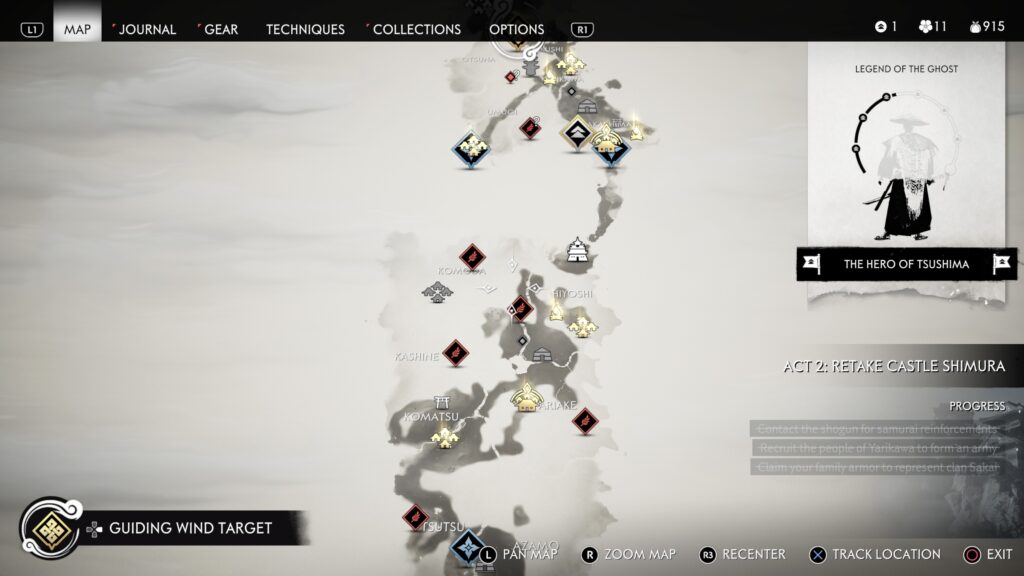
You can freely explore the island, which is a beauty, with markers on the map. The most interesting and original thing I've seen at least, I didn't know if another game had the mechanics is that you mark the objective on the map and normally, you leave the map and a marker or something noticeable appears to go to that marked point. Well, here it is not like that, but it uses the famous wind guide, which I think is a very good idea so that the marker is not invasive in the landscapes of the game. The wind is telling you the direction according to the target marked on the map. Also, riding a horse while going to your target with the wind blowing and the flowers moving looks very nice; it even sounds a bit poetic.
Jin can gradually unlock skills known as technique points, both samurai and ghost, which would be more like ninja. You have a decent sized skill tree for each style. You can also customize armors that have special effects, some better than others, as in every game, amulets and dyes for the armors, which in my case I never gave them importance; I liked the armor I put on Jin as it was.
The game has a wide variety of content, such as duels, hot springs, haikus and shrines, which can be challenging at times, but not difficult to accomplish. The most famous one, and the one that I feel grabbed the player the most, was the foxes that lead you to a shrine. In my game, I would see the fox and immediately jump off my horse. There are also some birds that guide you to some point of interest. You have to keep an eye on the world to discover more activities.
I think the bad thing about the game, as it happens to almost every open world, is its repetitiveness. Yes, when you've been playing for more than 25 hours or 100%, you're going to feel a little tired, because the missions can be doing the same thing all the time: go, infiltrate a camp, kill everyone and that's it, mission accomplished. At the beginning it's fun, but when you've been playing for more than 30 hours it can get a bit tedious. If you upgrade Jin, you can do this faster.
Another negative point can be the artificial intelligence of the enemies which is also repetitive and over time, you memorize everything, so the combat stops being a challenge and becomes more monotonous. A Mongol is not going to surprise you; they have fixed and predictable mechanics. At the beginning it has a normal, intuitive learning curve, and then it becomes something you do almost by inertia.
Many players experience it, but the camera is sometimes unbearable because it doesn't allow you to see the environment well. Still in open spaces it is not a problem; however, in closed spaces it is a headache.

Exploration may not be the best for some; in my case, I didn't see much of a problem, as it's completely understandable that the game feels empty in some parts. If we go back in time, imagine what the world was like in the 1200s, you weren't going to find a fried chicken stand on every corner or an outlet on every street. That's why I think it's a more realistic game, according to the time. I say this because don't expect to find a lot to do in every tree you see, because it's not going to be like that, and it doesn't have to be.
The gameplay is well done; it does have points of improvement, but overall, despite the repetitiveness of the missions, it is still a satisfying combat and for me, one of the best it has to offer. I remember it as a game that amused me for many hours.
Graphics and visual design
The graphics are excellent, very worthy of a game of its category and year for the PS4 console. The artistic design of the enemies and characters from Mongolia and Japan is very well set, and by their armor you can differentiate which side each one is from. The highlight is a very realistic art style, which I adored, inspired by Akira Kurosawa's cinema; it even includes a black and white Kurosawa mode with that unique filmic style. In my case I didn't play it that way, but it may be worth a try.
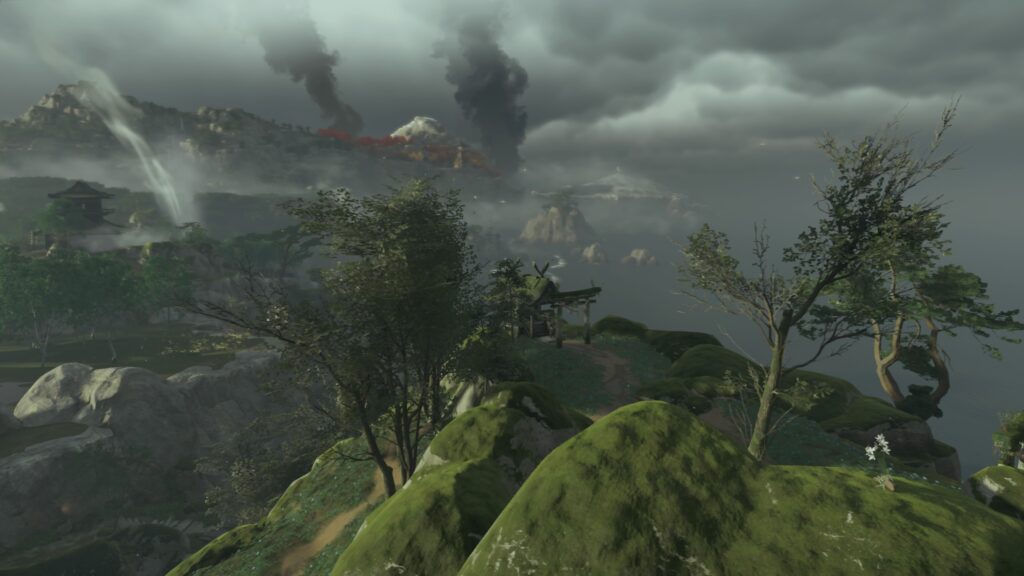
The natural setting is excellent; you do feel like you are in the 1200s in feudal Japan, and there is a variety of flora and fauna, which gives the game even more realism. The landscapes are beautiful; in general, the island is a visual beauty. On an artistic and visual level it is excellent.

Sound and music
The soundtrack is mostly melancholic, with traditional Japanese instruments (shamisen, shakuhachi). I feel that it complies well; however, it is not the strongest thing in the game, it feels that they focus more on the visual than the auditory. It complies in the moments of action and calm, although there are parts of the world where it is quieter altogether.
The sound effects are detailed, from the whistling of the wind to the clashing of katanas. I think the sound effects are the highlight in the sound section; hearing the katana cut enemies and cut through them is very satisfying, it almost sounds like the game is congratulating you for defeating it. Perhaps they could have improved the effects in the interaction with other elements or objects on the map.
The game offers voice acting in both English and Japanese. To give it more realism, I decided on Japanese voices and I feel that it delivers well. I don't feel that I can highlight a character as such; Jin's character is fine, but it's not outstanding enough to say that his performance was excellent. With the other characters less so, where perhaps the little participation doesn't help them much. So the voice performances are only okay.

Difficulty and accessibility
Difficulty depends on how you adapt to the mechanics, but having difficulty selection shouldn't be a problem. The “lethal” difficulty is one hit and you're practically dead, which intensifies the realism. You can play everything without a problem on easy, and so it will be a good experience for many.
In terms of accessibility options, it has options for subtitles, text sizes, contrast mode and assistance settings, among others. I consider it to be very complete for a game of its level and in comparison with other similar titles.

Additional content
You can take about 25 to 35 hours for the main story and, for the rest, about 50 to 60 hours, which is a pretty good time. It has enough content to keep you hooked to the game. It offers a variety of side activities, which I highly recommend. Replayability will also depend on how willing you are to replayability; I don't consider it a game to play or replay several times because of its length, which is normal. If you complete 100%, I don't see what else to do; once you get most of it, it takes it away.
It has expansions such as the Director's Cut, which includes the Iki Island expansion, which adds new abilities, enemies and a personal narrative for Jin. Highly recommended. It also has a cooperative multiplayer mode called Legends; I wasn't too interested in trying it, but maybe it's worth it.

Technical Aspects
Its performance on PS4 was stable at 30 fps, with fast loading times. The game squeezes the most out of the console and is giving closure to the console before the generation change. It improves considerably playing on PS5. In my experience, I played it during pandemic times, during the times of spending all day in the house; so I played the PS4 version and I have no major complaint. It ran very well for being open world, good optimization, and although it has some bugs with enemies, at least they are very passable, typical. There wasn't a single mission or side activity that was buggy or ruined my experience, so it's an excellently made game on a technical level.

Value for money
The game at launch cost about $59.99 USD and to be honest, these days it's hard to find games that are worth the full price. Well, in this case Ghost of Tsushima is completely worth every penny paid. If you get it on sale, so much the better, right? But even paying full price is a great recognition to Sucker Punch for everything they gave us in this installment: an excellent story and narrative, great gameplay, design and graphic quality according to the time, technically well worked, good soundtrack, lots of content and so on. From my point of view, the game has everything you need and is well justified its price, so do not hesitate to buy this game.
Trophies / Achievements
- Platinum obtained: Yes.
- Percentage of trophies obtained: 100%
- Estimated time: 50-60 hours. It took me approximately 51 hours.
- Platinum difficulty: 3 out of 10. The platinum is almost mandatory if you liked the game, the hardest thing really will be to dedicate so many hours, but it does not pose significant challenges. It is made for the player to get the most out of what the game offers and explore more of its world beyond its story, it's practically just completing 100% the game which I recommend because it's a lot of fun in my experience.
Conclusion
Ghost of Tsushima is one of those games that leave a mark on you. Not only for its incredible visuals or for how well recreated feudal Japan is, but also because it manages to convey emotions, dilemmas and decisions that really make you feel part of the story. Jin Sakai is a memorable protagonist, with a deep development that is rarely seen in a single installment. The narrative is so well written that it has no weak points and the ending is one of the best I've seen in a video game.
At the gameplay level, it's solid and very entertaining, with combat that feels satisfying and well thought out mechanics, although it can get a bit repetitive as the hours go by. Graphically it is a work of art, with an impressive setting that makes you feel inside the Japan of the thirteenth century. The soundtrack accompanies correctly, although it does not stand out as much as the visual design. Technically, it is stable, fluid and very well optimized, even on PS4, which shows the great work of the studio.
Overall, Ghost of Tsushima is a very worthwhile game that I recommend to every gamer. In my opinion it is the game with the best narrative of 2020 and it is my GOTY of 2020.
My final rating for Ghost of Tsushima is:
4.6 / 5.0

