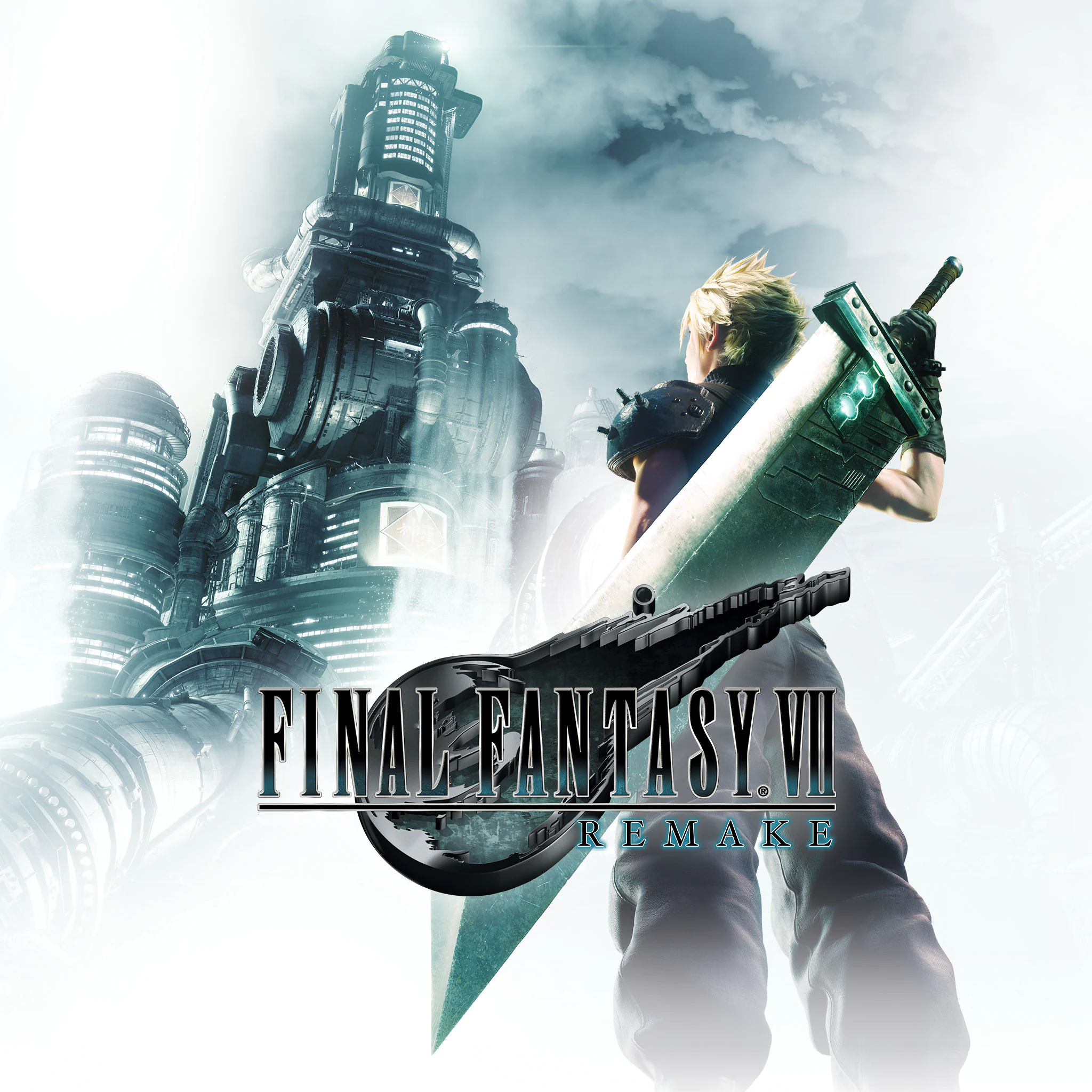




Image credit: PlayStation / Sony Interactive Entertainment promotional art.
Source: PlayStation
Summary
- Name of the gameFinal Fantasy VII Remake
- Launch dateApril 10, 2020
- Developer: Square Enix Business Division 1
- Publisher: Square Enix
- Platforms: PlayStation 4, PlayStation 5 (Intergrade), PC
- Genre: JRPG (Japanese Role Playing Game), Real Time Action
- ContextRemake of the iconic 1997 RPG, Final Fantasy VII, reimagined with modern gameplay and an episodic approach. This installment covers only the Midgar portion of the original story, expanded with great detail and narrative depth.
History and narrative
Final Fantasy VII Remake follows Cloud Strife, a former elite soldier turned mercenary, who joins the eco-terrorist group Avalanche in their fight against Shinra, a mega-corporation that ruthlessly exploits Mako, a vital energy resource for the planet. The story opens in Midgar, a city with an impressive engineering design that separates the social classes: the rich live above, the poor below. This division reinforces the game's message of inequality, with lower classes living in such precarious conditions that their sky is a metallic structure, illuminated by the artificial glow of the Mako.
I found this premise fascinating and original, especially the depiction of Shinra as a corporation that extracts natural resources in an abusive way, very much in line with the reality of many mega-corporations today. The story grabbed me from the start because of these social and environmental issues, and how the characters living “down under” seek to fight for equality and justice.
However, this strong narrative approach starts to fall apart in the last two chapters. I never played the Final Fantasy VII original, and this was my first experience with the saga, so I was expecting a coherent and complete story. But the final narrative twist introduces Sephiroth, an iconic villain of the franchise, in a way that felt forced and disconnected from the main plot thread.
Suddenly we go from a fight against Shinra to an abstract battle with Sephiroth, who manipulates Cloud and takes him to some sort of parallel dimension. The battles become exaggerated, almost unreal, and a scene appears with Zack Fair, a key character from Cloud's past who apparently survives when he was originally supposed to die, hinting at the existence of alternate timelines.
The whole thing felt confusing and abrupt to me. Perhaps for those who know the original story it makes sense, but for someone new like me, the ending felt disconnected from the rest of the game, as if it had gotten out of the narrative that had hooked me.
That said, the remake shines in the emotional depth it gives its characters. Barret, Tifa, Aerith and Cloud are all very well developed. I especially liked the dynamic between Aerith and Cloud, though there's also a love interest with Tifa (and even Jessie incredibly my favorite). The game suggests that they are all interested in Cloud, who, oddly enough, comes across as cold and indifferent.
The dialogue is well-written and nuanced, and the city of Midgar feels alive and oppressive, with an impressive level of urban detail not seen in the
original game. In short, the story is excellent for most of the game, but loses its way towards the end with too radical a change in tone that may disappoint new players.
Gameplay
The gameplay combines real-time combat with tactical elements of classic RPG. You can switch between characters, use skills and spells by briefly pausing time with the tactical menu. It's a system I hadn't experienced before and it surprised me for the better, as it forces you to be more strategic rather than just “button mashing”.
The game's controls are very responsive, and the gameplay is very responsive and easy to understand. The material system (skills and upgrades that you can equip) was a bit confusing at first, especially for the technicality of some descriptions, although over time it becomes more intuitive.
One of the downsides is that some enemies, especially bosses, are real hit sponges. Even knowing their weaknesses, it sometimes feels like you barely hurt them, while they can wipe out your team with a single attack. The AI also fails to avoid critical attacks, which can make you lose the fight frustratingly.
The controls are well optimized for keyboard and controller. Switching between characters is intuitive, although in chaotic moments it can be overwhelming. The camera sometimes makes it difficult to see the environment, leading to attacks you don't see coming.
The mini-games are varied and generally fun, some even more challenging than boss fights, which may seem like overkill, but they are worth it. The side quests are also interesting. Although the game is linear, it allows you to explore quite a bit within the confines of the design, and exploration feels natural and intuitive.
The learning curve is intermediate. If you have already played other Final Fantasy games, it will be easier. But if it's your first game in the saga (as in my case), it can take several hours to understand all the mechanics. Sometimes, fewer elements would have been better to ease the experience.
Graphics and visual design
Character modeling is outstanding, especially in the main characters. Facial animations are detailed and expressive. On PS4, some textures (such as doors or walls) have low resolution, but on PS5 or PC (Intergrade version) the graphic quality improves significantly.
The visual style mixes stylized realism with cyberpunk aesthetics. Midgar is dirty, decadent, full of neon and industrial details that convey the dystopian tone very well. Each sector has its identity, and many feel memorable, either by design or by the time you spend in them.
Enemies and bosses have designs very much in keeping with the game's atmosphere, and Shinra's base, with its Mako green hue, is simply spectacular. Visually, it's on par with other AAA games of its time.
Sound and music
The soundtrack is exceptional. The re-orchestration of classic themes such as “One-Winged Angel” and “Aerith's Theme” by Nobuo Uematsu is impressive. There is a wide variety of musical styles (rock, jazz, orchestral) that keep the experience fresh.
However, a negative point is that some pieces are repeated in unsuitable contexts, such as listening to an epic music in a fight against simple soldiers, which makes it lose impact. You hear an epic music against a boss and then the same against some little soldiers.
The sound effects are very well implemented: from sword strikes to the sounds of the urban environment. Even the menu sounds caught my attention.
attention. The voice acting is phenomenal in both English and Japanese. I especially liked the voice of Aerith (Briana White), who conveys her personality perfectly. Cloud (Cody Christian) also stands out, although all the characters are very well acted.
Difficulty and accessibility
The difficulty in normal mode is fairly balanced, although some bosses can feel unfairly difficult due to their length and mechanics. Easy mode allows you to enjoy the story without much hassle. The hard mode, unlocked at the end of the game, removes healing items in combat, offering a real challenge that requires mastering all the mechanics of the system.
In terms of accessibility, the game includes basic options such as subtitles and text adjustment, but lacks specific functions for people with visual or motor disabilities.
Additional content
The main campaign can last between 25 and 35 hours, depending on how many side quests you complete. Obtaining the 100% can take more than 60 hours. Although it is a linear game, there is plenty of optional content worth exploring.
Replayability depends on the player's profile: if you like to explore everything or complete challenges, you will find reasons to come back. There are mini-games, gym challenges, combat challenges, and more. Most are well designed, although some can become more difficult than certain main battles.
The game has a DLC called “INTERmission” starring Yuffie Kisaragi, which adds about 5-6 hours of additional content. I didn't play it, but if you enjoyed the base game, it's probably worth it.
Technical Aspects
On PS4 the performance can have occasional FPS drops, so I don't recommend it much on that console. On PS5 or PC, it runs much smoother at 60 FPS, with significant graphical improvements. Some minor graphical bugs, such as textures not loading on time, may occur, especially in the PS4 version, but nothing that breaks the experience.
Trophies / Achievements
- Platinum obtained: No
- Percentage of trophies obtained: 58%
- Estimated time: 60 to 80 hours
- Platinum difficultyDifficult mode and combat challenges require strategy and skill. It is a very long platinum, although there are longer games 80 hours feel longer for being a more linear game so it also becomes heavy, the mini-games can complicate a little more the trophy. It is highly recommended 2 passes something that to be a long and linear game also may not encourage you to want to play it 2 times. Some fights are too long and if you die you have to start from 0 so it requires a lot of patience.
Conclusion
Final Fantasy VII Remake is a bold, emotional and technically impressive reinterpretation of a classic that marked generations. Although it covers only a portion of the original story, it manages to expand that segment with a rich narrative, modern gameplay mechanics and a dazzling audiovisual presentation. For JRPG fans or those looking for a deep and well-told story, this is a must-play experience. It has many elements to improve already described, however, it enters my top 5 best games of 2020.
My final rating for Final Fantasy VII Remake is:
4.4/5

